
By Richard Cowan and Sarah N. Lynch
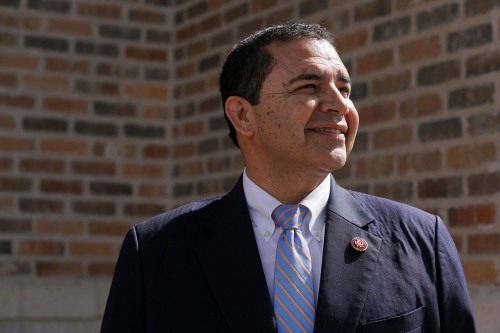
WASHINGTON, Dec 3 (Reuters) – U.S. President Donald Trump on Wednesday said he was granting a “full and unconditional pardon” to Democratic Representative Henry Cuellar of Texas, and his wife Imelda, who were charged with bribery.
Last year, Cuellar and his wife were indicted for allegedly accepting close to $600,000 in bribes in two schemes meant to benefit an Azerbaijani state-owned energy company and an unnamed bank based in Mexico.
He has maintained his innocence and that of his wife.
With a pardon from the Republican president resolving his legal problems, Cuellar is seeking a 12th two-year term, backed by the Democratic Party establishment.
In thanking Trump on social media, Cuellar said: “This pardon gives us a clean slate. The noise is gone. The work remains. And I intend to meet it head on.”
Trump, speaking to reporters at the White House, linked Cuellar’s indictment to his immigration policies, saying, “He was treated very badly because he said that people should not be allowed to pour into our country, and he was right. He didn’t like open borders.”
Cuellar has the reputation of being the House’s most conservative Democrat. He opposed former President Joe Biden’s move to lift a provision allowing U.S. border agents to turn away migrants to prevent the spread of the coronavirus. Trump had instituted that move when the virus began to spread during his first term.
Cuellar also pressed for more immigration judges to hear asylum cases and in 2021 joined with other lawmakers in urging Biden to improve the U.S. process for granting asylum. By 2023 he embraced a Biden administration rule on restricting asylum.
Cuellar, whose district relies heavily upon two-way trade with Mexico, voiced concerns about Trump’s border wall.
“Border walls are a 14th-century solution to 21st-century problems,” he said on November 4.
He voted against a House of Representatives move to impeach former Homeland Security Secretary Alejandro Mayorkas and he opposed requiring a citizenship question in U.S. census data.
A source with direct knowledge of the pardon said that in the lead-up to the decision, Cuellar hired a lawyer who had served in Justice Department leadership positions during Trump’s first presidential term. The source said that the former official sought to have the Justice Department dismiss the case, saying that it was an example of improper weaponization.
House Democratic Leader Hakeem Jeffries, not taking any chances that Cuellar could be persuaded to switch party allegiance and run as a Republican, lavished praise on the Texan, calling him a “beloved” House member and a “highly valued” member of its Democratic Caucus, in an interview with CNN. Jeffries also said he thought Cuellar’s indictment “was very thin to begin with.”
Cuellar, first elected to the House in 2004, has more recently fended off primary challenges from more progressive candidates in the party.
The Democratic Party’s congressional campaign committee has put Cuellar on its list of incumbent Democrats it is defending for re-election with additional resources because they could face stiff challenges in the 2026 midterm elections.
Trump’s Justice Department has largely dismantled its Public Integrity Section, which was erected after the Watergate scandal to investigate and prosecute the country’s most politically sensitive cases.
As the section has unraveled, Trump has pardoned or commuted sentences for many of the defendants in cases that remained outstanding in 2025, including former Tennessee House Speaker Glen Casada, former Tennessee state lawmaker Brian Kelsey, a former Virginia sheriff and a Las Vegas councilwoman.
He also commuted the prison sentence for former Republican Representative George Santos. All of these prosecutions, as well as Cuellar’s, were secured by the Public Integrity Section.
(Reporting by Katharine Jackson, Ryan Patrick Jones, Richard Cowan and Sarah N. Lynch; Editing by Caitlin Webber, Franklin Paul and David Gregorio)