By Ahmed Rasheed, Maha El Dahan, Humeyra Pamuk and Anna Hirtenstein
BAGHDAD/WASHINGTON, Dec 4 (Reuters) – Iranian drones swept through the mountain air of northern Iraq’s Kurdistan region in mid-July, homing in on their targets: oilfields run by Americans.
Fired by an Iranian-backed militia group within Iraq, likely in retaliation for U.S. strikes on Iran’s nuclear sites weeks earlier, one struck the Sarsang field operated by HKN Energy, a company owned by the son of Texas billionaire Ross Perot.
Another hit a nearby field run by Dallas-based Hunt Oil.
By the end of the four-day assault, which also disrupted operations at a local company and Norway’s DNO, nearly half of the Kurdistan region’s production had been halted.
The direct attack on U.S. interests enraged Washington, which had long felt Iraq was not doing enough to tackle pro-Iranian militias, and spurred it to ramp up a pressure campaign on Baghdad, according to nine sources familiar with the matter.
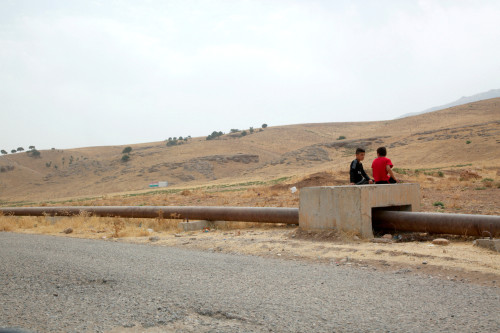
That campaign ultimately led to Iraq reopening a key export pipeline for Kurdistan’s oil – a major concession that points to a tilt in the balance of influence within Iraq away from Tehran and towards Washington.
“I think it’s safe to say Secretary (of State Marco) Rubio delivered some tough messages to Baghdad to make it clear that a moment of choosing was at hand,” said a source within the Trump administration about the U.S. response to the drone strikes.
SANCTIONS THREAT
Washington had been pressing for the pipeline to Turkey’s Ceyhan port to be reopened ever since it was closed in 2023 amid a dispute between Baghdad and the Kurdistan Regional Government (KRG) over oil sales that cut out the federal government.
That was partly to help U.S. oil companies in Kurdistan, partly to try to bring down global oil prices, and partly because the pipeline’s closure diverted crude south, feeding smuggling networks that generate huge sums for Iran and its proxies.
But the drone strikes prompted U.S. President Donald Trump to take Washington’s campaign to another level.
In the two months following the attacks, his representatives threatened Iraq’s top energy officials with sanctions if the pipeline was not restarted, said one of the sources involved in the pressure campaign.
A senior State Department official would not confirm or deny the sanctions threat, but said the U.S. applied “extremely intensive” diplomatic pressure for the pipeline restart.
The White House declined to comment on whether it threatened sanctions on Iraq. The Iraqi government, the KRG and Hunt Oil declined to comment. HKN Energy didn’t respond to requests for comment.
A preliminary agreement to restart the pipeline was announced on July 17, the final day of the drone attacks, and after two months of intense U.S. pressure, oil began flowing on September 27.
Details of the U.S. pressure campaign have not previously been reported.
No group has claimed responsibility for the drone attacks. An Iraqi government source, citing an investigation by its security services, said they were the work of a powerful pro-Iranian militia group, which he declined to name.
An Iraqi security source said Baghdad warned the group that any further attacks would put it in direct confrontation with the government.
US EXPECTS ‘SIGNIFICANT RETURN’ ON ITS INVESTMENT
The episode highlights U.S. energy ambitions in the Middle East. Iraq is the second-biggest producer in the Organization of the Petroleum Exporting Countries, which Trump has regularly criticised for trying to keep oil prices high.
It also underscores the close links between U.S. diplomacy and U.S. business interests under Trump.
“Having invested so much in this country … in terms of national treasure and loss of U.S. lives alongside our Iraqi partners in the defeat of terrorism, … we expect there to be significant return on that investment,” the U.S. administration source said.
Iraq’s concession, meanwhile, hints at a shift in the balance of influence in the country.
Baghdad has long walked a diplomatic tightrope between its key allies – but also arch-enemies – Tehran and Washington.
Iran, which is under U.S. and Western sanctions for its nuclear ambitions, backs about 10 hardline Shi’ite armed factions operating in Iraq that command about 50,000 fighters and arsenals, and it holds extensive political sway.
But its power and prestige have been severely weakened by Israeli attacks against its proxies in the region and Iran itself.
COMPLICATIONS
It is unclear, however, whether this power shift will persist, or how durable the pipeline deal will prove.
The pipeline resumption agreement is temporary and up for review by Baghdad and the KRG at the end of December.
The future is also complicated by the expiry next July of a 1973 agreement between Iraq and Turkey that sets the legal groundwork for oil exports.
Baghdad also continues to oppose two Kurdistan gas deals struck by HKN Energy and Vancouver-based WesternZagros with the KRG in May.
HKN is part of the Dallas-based Hillwood real estate and energy group founded by Ross Perot Jr., son of Ross Perot, a self-made Texan billionaire and two-time presidential candidate.
The Perot family is a major supporter of the Republican Party, donating more than $3 million in both 2025 and 2024, according to public records.
Baghdad says agreements over Iraq’s natural resources can only be made with the federal government. It filed a lawsuit against the KRG over the deals on May 26, and in the same week signed a deal with China’s Geo-Jade Petroleum to expand an oilfield in southern Iraq.
Still, there are signs of U.S.-Iraqi relations improving.
Washington put forward a new special envoy to Iraq on October 19, days after U.S. energy giant Exxon Mobil agreed to re-enter the country to help expand production in southern Iraq.
“It’s a first very important step in terms of the work we want to go do,” Exxon CEO Darren Woods told a conference in London on October 13. “We’ve got a pretty long road ahead of us in terms of anything coming to fruition, but we’re optimistic and looking forward to evaluating that.”
(Reporting by Ahmed Rasheed in Baghdad, Maha El Dahan in Dubai, Humeyra Pamuk and Timothy Gardner in Washington, Dmitry Zhdannikov and Anna Hirtenstein in London, and Nerijus Adomaitis in Oslo. Editing by Richard Valdmanis and Mark Potter)